Can intention
bend chance?
A scientifically grounded Android app for exploring the relationship between focused intention and measurable physical reality — using genuine quantum random numbers, multi-sensor recording, and longitudinal statistical analysis.
The hypothesis
behind the experiment
Between 1979 and 2007, Princeton University's PEAR Lab ran one of the most sustained scientific investigations into mind-matter interaction ever conducted. The results were small and contested — independent replication was inconsistent, and the scientific consensus does not endorse the hypothesis. But the dataset was never fully explained away either. This app gives you the instruments to ask the question with your own data, honestly, over time.
Genuine quantum random bits, generated from vacuum fluctuations by Cisco Outshift's QRNG server. Physically independent of your device — no sensor crosstalk, no classical noise coupling.
Z-scores computed from the binomial distribution against the theoretical 50/50 baseline. Phase analysis isolates early, mid, and late intention independently — the same approach as PEAR.
Six independent physical channels recorded simultaneously. When quantum RNG and the magnetometer deviate in the same five-second window, that convergence is harder to attribute to noise than either channel alone.
Single sessions are statistically inconclusive by design. The effect documented by PEAR had an effect size of approximately 0.0003 — it required years of accumulated data to emerge. Your vault is where meaning lives.
What gets
recorded
Every session records six independent channels simultaneously, each with its own noise architecture. The spatial heatmap in your results shows when multiple channels deviate in the same time window.
Live or buffered quantum random bits from Cisco Outshift vacuum fluctuation measurements. The primary experimental channel — genuinely non-deterministic and physically isolated from your device.
Ambient magnetic field in microtesla (μT). The heart generates an electromagnetic field detectable several feet from the body. Baseline-referenced so environmental drift is accounted for.
Sound amplitude in decibels. No audio is recorded or stored — only the instantaneous dB value. Environmental acoustic stability is factored into session coherence scoring.
Atmospheric pressure in hectopascals (hPa). Provides a slow-changing environmental baseline. Convergent deviations with RNG in the same window are logged for review.
Signal strength of connected WiFi network. RF environment fluctuations — devices connecting, interference events — are tracked and available as a convergence channel in the heatmap.
RSSI variance across nearby Bluetooth devices. Variance spikes indicate RF environment shifts. Included as a passive environmental witness channel alongside WiFi.
Consumer phones produce random numbers from their entropy pool — CPU timing, sensor jitter, touch events. These are classically random but not physically independent of the device. A quantum RNG sources from vacuum fluctuation measurements on dedicated optical hardware at a remote server. There is no physical coupling between that apparatus and your phone's sensors. If deviation appears in the quantum channel, it cannot be explained by hardware crosstalk — which is precisely why it is the scientifically preferred source for this research.
How a session
works
The Advanced Lab follows a structured four-phase protocol derived from PEAR methodology. Each phase serves a specific statistical function.
Record your current intention, energy level, stress level, and mood. These are stored with each session and available for longitudinal correlation analysis in the vault — allowing you to identify conditions under which your results are consistently stronger or weaker.
All sensors record simultaneously before you apply any conscious intention. This establishes the environmental reference point for the session — magnetometer baseline, acoustic level, RF environment, and entropy pool state. Without an established baseline, deviation is unmeasurable.
The active experiment is divided into early, mid, and late periods. Each produces its own isolated z-score computed only from samples within that period — not cumulative from session start. This structure tests whether the effect sustains, builds, or declines across a session, mirroring the decline effect documented in PEAR data.
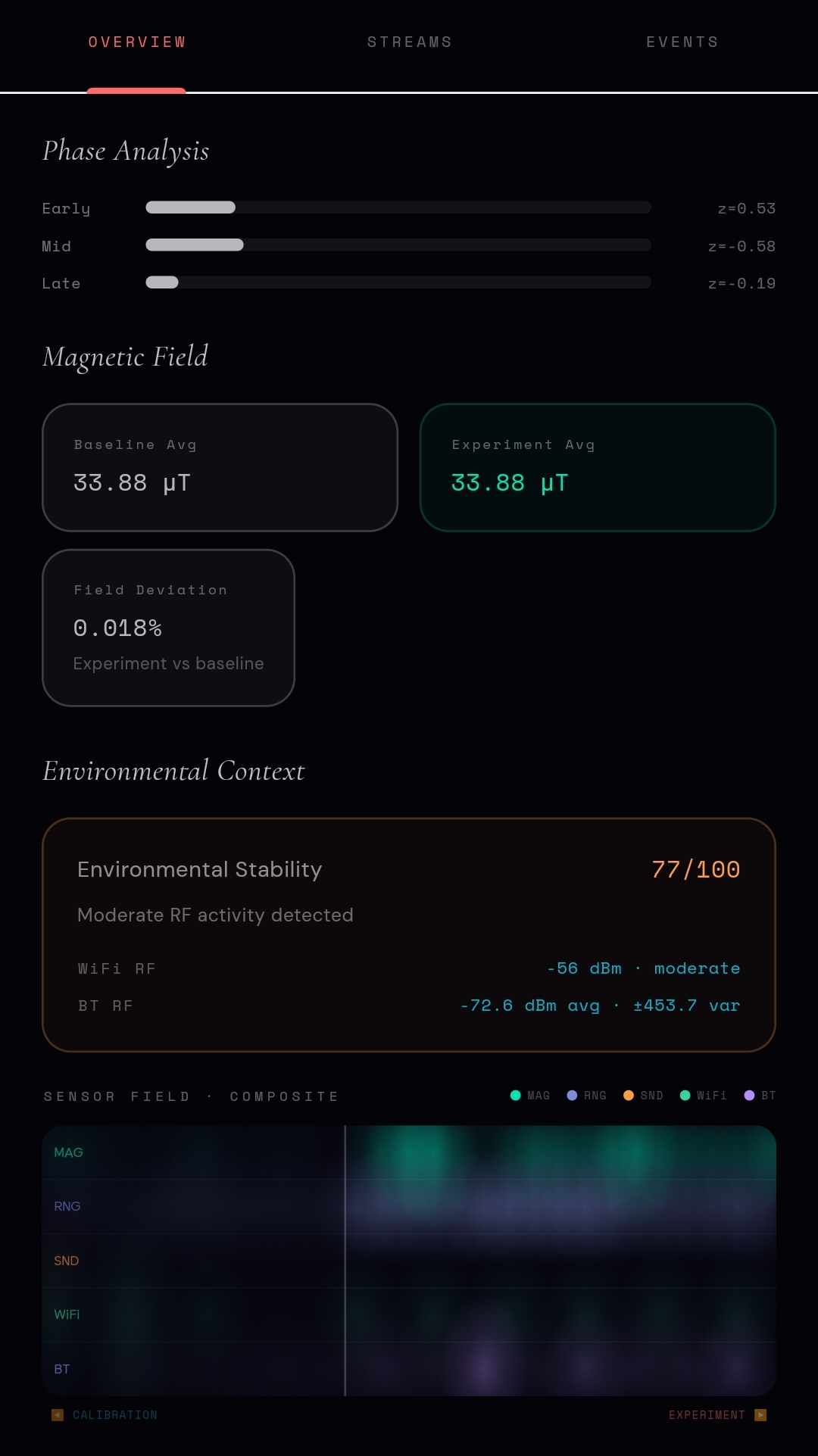
Session results include z-score, deviation percentage, phase analysis, a spatial heatmap showing multi-channel convergence events, and a coherence score indicating session quality. All sessions are stored locally and accessible in the vault for pattern analysis across your personal dataset.
The science
behind the question
Nine in-app articles covering the research, the physics, and the epistemology — so you understand exactly what you are measuring and what it might mean.
An honest accounting of PEAR, GCP, and the criticisms that matter — before exploring what genuinely remains open.
What "observer" actually means in physics — and why the popular claim that quantum mechanics validates consciousness research is a misreading.
HeartMath research, bioelectromagnetics, and what the heart's electromagnetic field actually means physically.
Copenhagen, Many Worlds, Transactional — and why the choice between them matters for this experiment.
Three protocols, three experimental questions. Why local entropy and quantum RNG test fundamentally different things.
The hard problem, IIT, Orch-OR, Global Workspace Theory — and where they leave the research.
What z-scores, phase analysis, coherence scores, and multi-channel convergence actually mean statistically.
Environment, intention framing, duration, and control sessions — the protocol decisions that determine data quality.
Why finding nothing is finding something. The file drawer problem, Bayesian reasoning, and sitting with uncertainty.
Nothing leaves
your device
The app makes one external connection: to the Cisco Outshift QRNG API to fetch quantum random numbers. All session data, all analysis, all results — stored locally on your device only.
No email, no profile, no authentication of any kind. Nothing to identify you.
No SDKs, no crash reporting, no usage data. The app has no visibility into how you use it.
Microphone permission is used only for instantaneous dB measurement. No audio is captured, stored, or transmitted at any point.
Free, ad-free. The app is funded entirely by voluntary contributions from users who find it valuable.
What it looks
like in practice
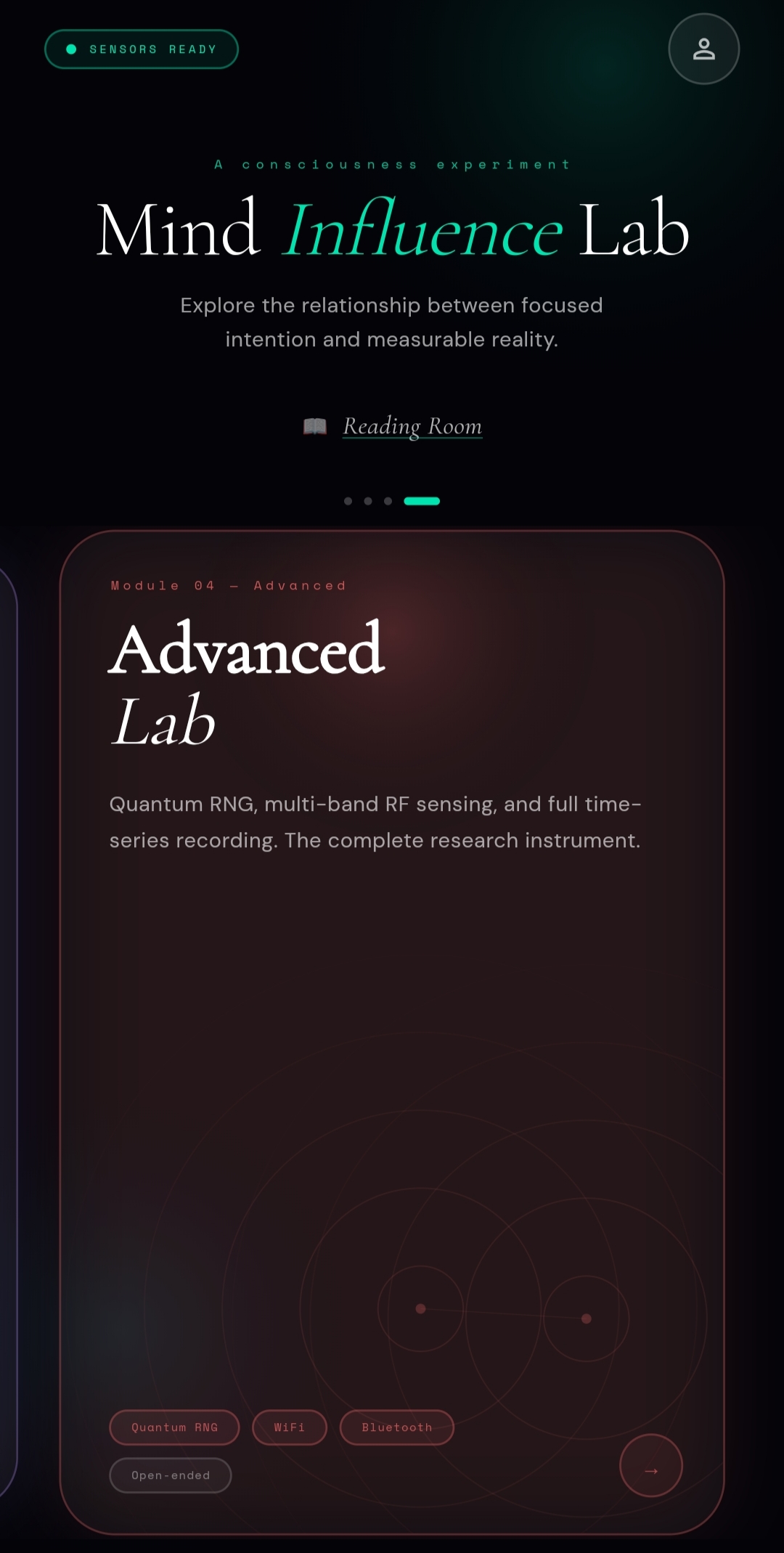
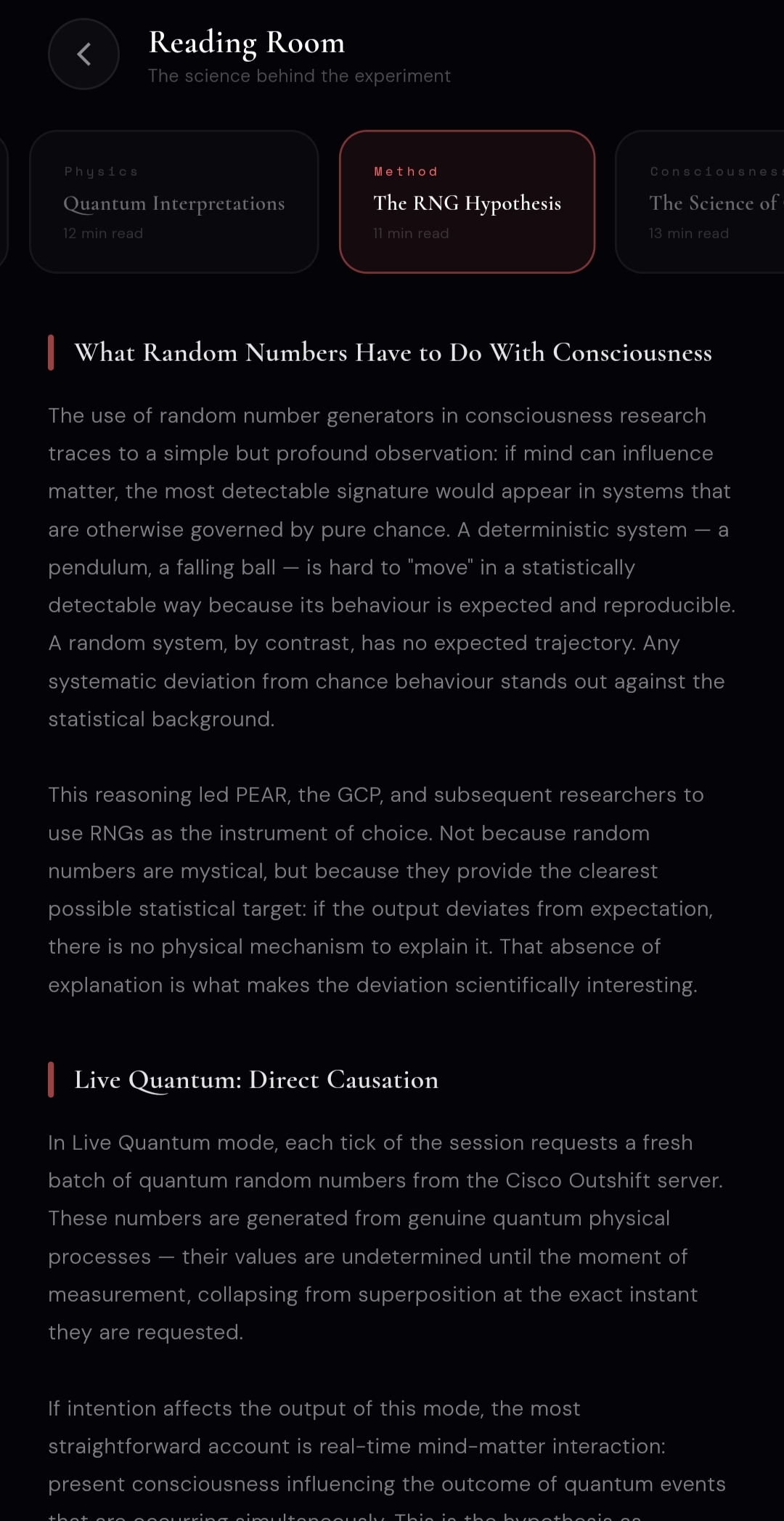
Three screens from the v2 release. The design is built around legibility of data — nothing decorative that isn't carrying information.
A PRNG running
in your browser
This is a demonstration only — it uses your browser's built-in CSPRNG (window.crypto.getRandomValues()), the same entropy source the app uses in Local Entropy mode. It is not connected to quantum hardware. The visualisation is here so you can see the interface and what a running z-score looks like before downloading anything.
Frequently
asked
Release History
This app is a personal research tool for exploratory and educational purposes only. It is not a medical, diagnostic, or scientific device. The hypothesis that consciousness can influence random physical systems is not established science. Single sessions are statistically inconclusive. This app is not affiliated with Princeton University or the PEAR research program. All findings referenced are from published or publicly available sources and should be evaluated critically.